
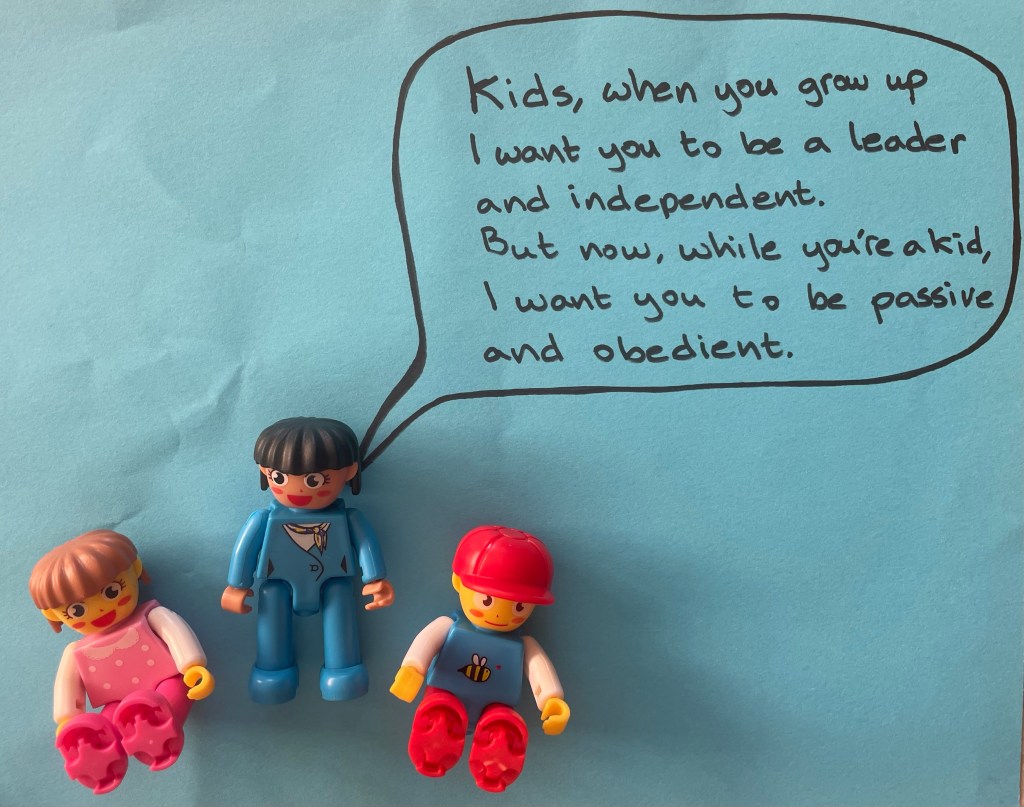
Many parents wish for their children to grow up into independent individuals. They aspire for their children to one day become responsible adults.
These wishes albeit understandably noble, are open to question. The challenge is twofold. Firstly, these aspirations are sometimes accompanied by non-congruent parenting styles. Secondly, these aspirations assume that the child today, whether they are 5, 10 or 15 years old, can not be responsible or independent.
Let’s take a closer look to explore each challenge.
Firstly, non-congruent parenting styles. Many parents wish for their children to grow into responsible and independent adults, yet they also want their children to be obedient and compliant now.
Do you see the schism here? Do you see the non-congruency in parenting style?
In order for a child to be independent when they are 25 years old, they will need to have been practicing their independence in age-appropriate ways at 20, 15, 10 and even 5 years of age.
Here’s the dilemma, how can you parent your child to be independent later and obedient now? I don’t think you can.
Children need multiple age appropriate opportunities to practice and grow their independent and responsible behavior. How can a parent do this? By ceding control to the child in age appropriate ways.
A parent’s role is not to control their child. A parent can control 1) themselves and 2) the immediate environment the child grows in. A popular example is mealtimes and eating habits. The parent can control the environment by choosing the variety of food available in the house, and when and where it will be served. The parent then cedes control of how much to be eaten to the child. In this way, the child learns to listen to their bodily cues, whether they are hungry or full, and to explore different foods from the preset variety.
Another example is clothing. The parent controls the environment by offering children appropriate clothing options and then cedes control to the child to choose what to wear. In doing so, the children have the valuable experience of listening to their body, and on a winter day ask themselves questions like “am I cold?” or “what does being cold feel like?” And can accordingly make the choice themselves to put on their jacket should they feel the need to.
Now I would like to move onto the second challenge and explore the idea of wishing children grow up to become responsible or independent adults. The notion of children “becoming”, within itself, assumes the child is not already. Aspiring a child “becomes” something in the future, implies they are not, and dare I say, can not be now.
A 5 year old can be independent when they dress themselves or pour themselves a glass of milk. They can also be responsible when they put on their jacket when they feel cold or eat when they feel hungry. A 10 year old can be independent when they do their homework or practice for a recital. They can also be responsible when they care for a younger sibling or put on their helmet to ride their bike. A 15 year old can be independent when they walk to school or do the family groceries. They can be responsible when they take care of the family pet and manage their allowances.
As you can see, independence and responsibility, is something that can be experienced at a younger age in age-appropriate ways.
The examples I used are just that, examples, not every child will demonstrate the same interests or behaviors, so please don’t use them as benchmarks. Instead, use them as examples to inspire ways that children can already exhibit traits of independence and responsibility, at various ages.
Small daily choices create behaviors and that’s how independence or responsibility is experienced.
I invite you to reflect on how you can encourage your child to practice these skills.
How can you nurture your child’s independence and responsible behavior?
In what ways can your child practice being independent and responsible today?
I would love to hear your ideas. Share with me below!
 Hend Helmy
Leave a comment